HELOC vs Home Equity Loan: Which One Wins in 2026?
American homeowners currently hold $11.6 trillion in tappable home equity according to ICE Mortgage Monitor data, with the average homeowner having access to roughly $204,000. Yet most of that equity sits idle, locked away while mortgage rates hover in the 6-7% range and homeowners who secured sub-4% rates during the pandemic refuse to refinance.
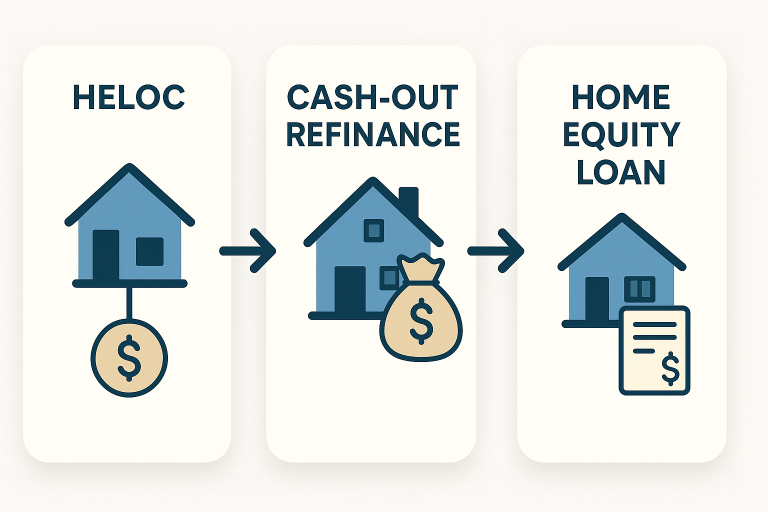
This is the era of the second mortgage. Whether you need to renovate a kitchen, consolidate high-interest debt, or cover college tuition, you’re likely deciding between two options: a Home Equity Line of Credit (HELOC) or a Home Equity Loan. Both leverage your home’s value. Both have distinct advantages. And in 2026’s shifting rate environment, choosing wrong could cost you thousands.
This analysis examines both products side-by-side using current market data and borrower scenarios. The goal is straightforward: give you a practical framework to evaluate which option aligns with your specific borrowing needs and risk tolerance.
The Rate Reality Check (Feb 2026)
Current HELOC Rates vs Home Equity Loan Rates
Here’s what you’re actually looking at in today’s market.
HELOC rates currently average 7.23% to 7.31% nationally, with Bankrate reporting 7.31% and Yahoo Finance at 7.23%. These are variable rates tied to the WSJ Prime Rate, which sits at 6.75%. Your actual rate depends heavily on credit: borrowers with excellent scores (720+) can secure rates around 7.0%, good credit (680-719) lands near 7.5%, and fair credit (<680) pushes into 8.5% or higher. Forecasters expect HELOC rates to average 7.30% through 2026.
Home equity loans currently range from 6.96% to 7.89% on average, with the most creditworthy borrowers seeing rates as low as 6.49%. Fair credit borrowers face 10% or higher. The 2026 forecast averages 7.75%.
The Federal Reserve’s current rate sits at 3.50-3.75%, with markets pricing in 1-2 cuts of 25 basis points in 2026. The next FOMC meeting is March 17-18, 2026, with a year-end target of 3.00-3.25%.
Why the Gap Matters Less Than You Think
At first glance, home equity loans appear cheaper. They’re not – necessarily. The difference between fixed and variable changes everything.
A HELOC’s variable rate means your payment fluctuates. If the Fed cuts rates as expected, your HELOC payment drops. If inflation reaccelerates, it rises. That uncertainty scares some borrowers. But it also creates opportunity. Home equity loans lock you in. If rates fall significantly, you’re stuck unless you refinance – and refinancing a second mortgage comes with closing costs and hassle.
The real question isn’t which rate is lower today. It’s which rate trajectory matches your risk tolerance and timeline.
How They Actually Work (The Critical Differences)
HELOC: A Credit Card on Your House
A HELOC functions like a revolving credit line secured by your home. During the draw period – typically 5 to 10 years – you can borrow, repay, and borrow again up to your limit. You pay interest only on what you actually use.
This flexibility is powerful. Starting a multi-phase renovation? Draw $30,000 for the kitchen now, another $20,000 for bathrooms later. Only pay interest on each amount when you actually spend it. Have irregular income? A HELOC provides a safety net without forcing you to pay interest on money you’re not using.
But there’s a catch: payment shock. During the draw period, most HELOCs require interest-only payments. When the draw period ends, you enter repayment – often 10 to 20 years of principal-plus-interest payments that can double or triple your monthly obligation. If you’ve been making minimum payments for a decade, that transition stings.
The variable rate adds another layer of uncertainty. Your $500 monthly payment could become $650. Or $400. You won’t know until it happens.
Home Equity Loan: A Second Mortgage
A home equity loan is simpler. You receive a lump sum upfront – say, $50,000 – and immediately start repaying principal plus interest on the entire amount. The rate is fixed. The payment is predictable. The term is typically 10 to 20 years.
This structure works beautifully for one-time expenses with defined costs. Consolidating $35,000 in credit card debt? You know exactly what you owe, what you’ll pay monthly, and when you’ll be debt-free. No surprises. No temptation to borrow more because the “credit line” is already exhausted.
The predictability comes at the cost of flexibility. Once you take the loan, you can’t borrow more without applying for a second loan. If you borrowed $50,000 but only needed $40,000, you’re paying interest on that extra $10,000 anyway. And if rates drop significantly, you’re stuck unless you refinance – which means new closing costs, new paperwork, and new qualification hurdles.
Which One Fits Your Scenario?
Choose a HELOC If…
You have ongoing or unpredictable expenses. Multi-room renovations, phased construction projects, or college tuition paid semester-by-semester are perfect for HELOCs. You draw only what you need, when you need it.
You want payment flexibility. Some months you can pay down principal aggressively. Other months you make interest-only minimums. This adaptability helps self-employed workers, seasonal businesses, or anyone with irregular cash flow.
You can tolerate rate uncertainty. If a rising rate environment would strain your budget, think carefully. But if you have wiggle room – and the Fed is expected to cut rates in 2026 – a HELOC could actually save you money compared to locking in a higher fixed rate now.
You want a backup emergency fund. Opening a HELOC costs little or nothing. Having it available – without drawing on it – provides peace of mind for medical emergencies, job loss, or unexpected repairs.
Choose a Home Equity Loan If…
You have a one-time, defined expense. Debt consolidation, a specific medical procedure, or a single major purchase fits the lump-sum structure perfectly. You borrow exactly what you need, pay it off systematically, and you’re done.
You need predictable payments. Fixed-rate mortgages exist for a reason: humans hate payment uncertainty. If knowing your exact monthly obligation helps you sleep at night, the home equity loan’s stability is worth the potential opportunity cost of missing rate drops.
You believe rates will rise. If you think the Fed’s projected cuts won’t materialize – or that inflation will force hikes – locking in a fixed rate today protects you from future increases.
You struggle with spending discipline. A HELOC’s revolving nature tempts some borrowers to treat it like a credit card, perpetually borrowing and extending debt. A home equity loan’s fixed structure forces amortization. Once you pay it off, it’s gone.
What You Need to Qualify in 2026
Credit Score Requirements
Lenders tightened standards after 2022, and 2026 continues that cautious approach. For HELOCs, expect minimum credit scores of 680 to 720. Many prime lenders want 720+ for their best rates. Home equity loans are slightly more forgiving, with minimums ranging from 620 to 680.
Your credit tier dramatically affects pricing. On a $100,000 HELOC, the difference between excellent (720+) and fair (<680) credit could mean 1.5 percentage points – translating to roughly $1,500 more in annual interest.
Equity and LTV Limits
Most lenders cap combined loan-to-value (CLTV) at 80% to 85%. If your home is worth $500,000 and you owe $300,000 on your first mortgage, you have $200,000 in equity. At 80% CLTV, you could borrow up to $100,000 (80% of $500,000 = $400,000 total debt minus your existing $300,000).
The average homeowner’s $204,000 in tappable equity sounds substantial, but LTV limits and lender risk appetite determine your actual availability. High-value markets and strong credit profiles see the most generous terms.
Maximum debt-to-income ratios typically range from 43% to 50%, including your existing mortgage, the new loan payment, and other monthly obligations.
Documentation Lenders Want
Prepare for a process similar to your original mortgage: recent pay stubs, W-2s or 1099s, tax returns, bank statements, and proof of homeowners insurance. Self-employed borrowers face extra scrutiny – two years of tax returns and possibly profit-and-loss statements. Lenders will order an appraisal, either full or automated depending on your equity position and loan amount.
The Tax Question
When Interest Is Deductible
Here’s where borrowers often get tripped up. Interest on HELOCs and home equity loans is only deductible if used to buy, build, or substantially improve the home securing the loan. Using your equity for debt consolidation, vacations, or college tuition? No deduction.
Even qualifying borrowers face limits. The deduction applies to interest on up to $750,000 of mortgage debt for married couples filing jointly ($375,000 for single filers). This includes your primary mortgage, so many homeowners hit the cap quickly. And you must itemize deductions – meaning your total itemized deductions must exceed the standard deduction ($29,200 for married couples in 2026) for the mortgage interest deduction to matter.
Common Tax Mistakes
Don’t assume your interest is deductible just because you have a mortgage product. Documentation matters. If audited, you’ll need to prove the loan proceeds went toward home improvements through receipts and contracts. Blending deductible and non-deductible uses on the same loan creates accounting nightmares. And remember: paying interest for a tax deduction is still paying interest. The deduction partially offsets the cost – it doesn’t eliminate it.
Making Your Decision
| Feature | HELOC | Home Equity Loan |
|---|---|---|
| Interest Rate | Variable (avg 7.23-7.31%) | Fixed (avg 6.96-7.89%) |
| Access to Funds | Revolving (draw as needed) | Lump sum |
| Repayment | Interest-only during draw period, then principal + interest | Fixed principal + interest from day one |
| Best For | Ongoing projects, flexibility | One-time expenses, predictability |
| Rate Risk | Payment fluctuates with Fed policy | Locked in – miss rate drops |
| Min Credit Score | 680-720 | 620-680 |
Quick Recommendations:
- Home renovation with multiple phases? → HELOC
- Credit card debt consolidation? → Home Equity Loan
- Need emergency backup (unused)? → HELOC
- Can’t stand payment uncertainty? → Home Equity Loan
- Expect rates to fall in 2026? → HELOC
- Expect rates to rise? → Home Equity Loan
Conclusion
The HELOC versus home equity loan decision isn’t about finding the “best” product – it’s about matching the right tool to your specific scenario. With $11.6 trillion in tappable equity sitting in American homes and 2026’s rate environment in flux, millions of homeowners face this choice.
If you value flexibility and can handle some rate uncertainty, a HELOC’s revolving structure and potential payment savings make sense. If you need predictability and have a defined one-time expense, a home equity loan’s fixed rate and forced amortization provide clarity.
Whichever path you choose, shop multiple lenders. Credit unions, online lenders, and traditional banks offer different rates and fee structures, and comparing terms can produce meaningful savings over the loan term. Your home secures both products. Borrow wisely.