Should You Touch Your 3% Mortgage in 2026? An Equity Decision Framework
The 3% Mortgage Reality
If you bought or refinanced between 2020 and early 2022, your mortgage rate likely falls between 2.5% and 3.5%. That rate no longer exists in the market. The 30-year fixed has spent most of the past two years above 6%, and even with recent dips to around 6%, current borrowers pay roughly double what you pay.
On a $400,000 balance, the gap between 3% and 6% runs $720 per month. Over ten years, that compounds to $86,000 in additional interest. Your rate functions as an asset. Treating it carelessly would cost you.
But that same mortgage now acts as a barrier. The average homeowner holds roughly $204,000 in tappable equity, according to ICE Mortgage Monitor data from late 2025. Forty-eight million homeowners have equity they could access while keeping the standard 20% cushion. Your home has likely appreciated significantly since purchase. That wealth sits locked unless you disturb your mortgage.
This is the tension. Your rate is cheap. Your equity is substantial. But accessing that equity requires either adding a second lien or replacing your first mortgage entirely. For homeowners weighing these paths, our complete guide to cash-out refinancing breaks down the full process. Both options interact with your 3% rate in ways that demand clear thinking, not gut instinct.
The Golden Handcuff Effect
Homeowners with rates far below current market levels face a structural constraint. Trading a 3% mortgage for 7% financing represents a significant financial setback, even when life circumstances push you to move or access equity. Housing inventory stayed constrained for years partly because millions of homeowners declined to make that trade.
The constraint is easing, but slowly. The share of mortgaged homeowners with sub-3% rates has dropped to roughly 20%, the lowest since 2021. New purchases at higher rates dilute the pool. Life forces sales despite the math. Some homeowners have grown accustomed to higher rates, accepting them as normal.
If you still hold a 3% mortgage, you occupy a narrowing position. The question is not whether your rate is good. It is whether that good rate should make you cautious or calculated. That answer depends on what you plan to do with equity and how long you will stay in the home.
When You Should Leave It Alone
Some situations argue for keeping your hands off the mortgage entirely.
Selling within three to five years makes equity access a losing proposition. Closing costs on a cash-out refinance run 2% to 5% of the loan amount. HELOCs carry lower upfront fees but often penalize early closure if you terminate the line within a few years. Short timelines do not let these costs amortize.
Using equity for discretionary spending rather than wealth-building activities is a warning sign. Vacations, vehicle purchases, or lifestyle upgrades convert secured debt into consumption inflation. The 3% mortgage you protect becomes meaningless if you layer on high-interest credit card debt or burn equity on depreciating assets.
Unstable income means avoiding new leverage. A HELOC adds a monthly obligation. A cash-out refinance raises your base payment. Both assume continued earnings. Home equity serves as a buffer against financial shocks. Converting it to debt during uncertain times strips away that protection.
Consolidating credit card debt without fixing the underlying spending pattern just repeats the cycle. The math works once. Few get a second opportunity.
When Accessing Equity Actually Works
Certain situations justify disturbing your mortgage.
High-return home improvements remain the classic case. Renovations that increase property value or generate rental income can justify the cost. Kitchen remodels, accessory dwelling units, and energy efficiency upgrades often recoup investment while improving livability. The test is whether the improvement yields returns above your cost of capital.
Debt consolidation works when the interest rate gap is wide enough. Credit cards currently average 20% to 24% APR. Home equity products hover around 7% to 8%. A borrower with $50,000 in credit card debt paying $1,000 monthly in interest alone could cut that burden significantly. The essential condition is behavior change. The credit cards must stay paid off, not reload.
Investment opportunities with clear risk-adjusted returns above your cost of capital can warrant the move. This means starting a business with proven revenue, acquiring rental property with positive cash flow, or funding education that materially raises earning capacity. Speculation does not qualify. Your home equity should not fund cryptocurrency speculation or untested ventures.
Emergency liquidity represents a defensible use, though ideally your equity serves as backup reserve rather than primary funding. A HELOC established before crisis hits provides a lower-cost alternative to high-interest emergency loans or forced asset sales.
HELOC: Preserve the Rate, Access the Equity
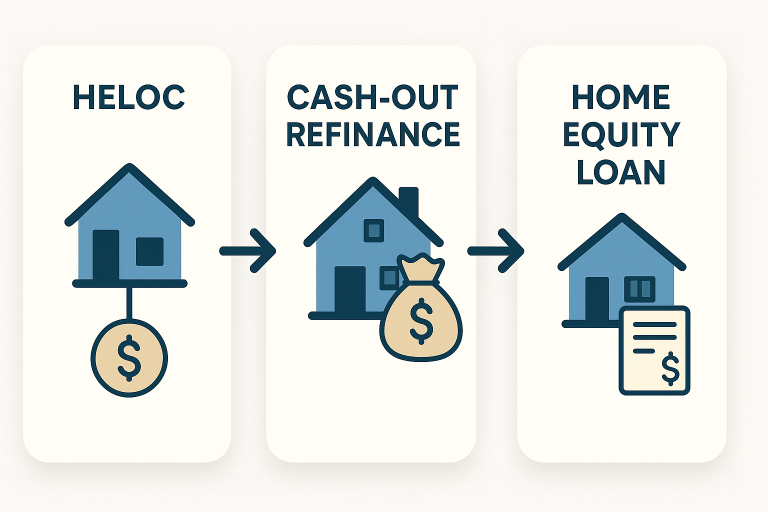
A home equity line of credit offers the most precise solution for homeowners who want to keep their 3% mortgage while tapping equity. If you are unsure whether a HELOC or fixed home equity loan fits your situation, our comparison of HELOC versus home equity loan explains the structural differences. A HELOC functions as a second mortgage with a variable rate tied to prime. You draw only what you need, when you need it, paying interest only on amounts borrowed.
Current HELOC rates average approximately 7.2%, though creditworthy borrowers can find rates in the mid-6% range. This is higher than your 3% mortgage but far below credit card debt, personal loans, or most consumer financing.
The advantage is surgical. Your primary mortgage stays intact at 3%. The HELOC sits behind it as a separate obligation. If you borrow $100,000 against $400,000 in equity, only that $100,000 carries the higher rate. Your original loan keeps amortizing on schedule.
The variable rate introduces uncertainty. HELOC rates move with Federal Reserve policy. The Fed has projected three rate cuts in 2026 totaling 0.75%, which would reduce prime and lower payments for existing borrowers. But projections fail. Your rate could rise if inflation returns or the Fed reverses course.
HELOCs fit homeowners with specific, time-bound equity needs. A kitchen renovation requiring $75,000 in draws over six months. A debt consolidation requiring a single $40,000 draw. A tuition schedule spread across four years. The flexibility matches irregular cash flow needs without forcing you to borrow a lump sum you do not immediately need.
Cash-Out Refinance: The Most Aggressive Approach
Cash-out refinancing replaces your mortgage entirely. You take a new loan larger than your current balance, receive the difference in cash, and begin payments on the full amount at current market rates. For a direct comparison of these two approaches, see our analysis of HELOC versus cash-out refinance to determine which structure fits your specific equity needs.
For 3% mortgage holders, this is the most aggressive approach. You are not preserving your rate. You are eliminating it. The decision only makes sense when the equity need is substantial, the use case is compelling, and the timeline is long enough to justify the rate increase on your entire balance.
Current 30-year fixed rates for cash-out refinances average approximately 6%, though rates vary by lender, location, and borrower profile. The spread between your 3% rate and 6% represents a permanent increase in base housing cost. On a $300,000 balance, that means roughly $540 more per month before accounting for any cash you extract.
The math shifts if you carry significant non-mortgage debt at high interest rates. Consolidating $100,000 in credit card debt at 22% APR into a 6% mortgage can produce net savings even after accepting the higher rate on your original balance. But this requires honest accounting. You must calculate the weighted average cost of all your debt before and after consolidation, including the rate increase on your mortgage principal.
Cash-out refinancing also applies when you need more capital than a HELOC can provide. Most HELOCs max out at 80% to 85% combined loan-to-value. Cash-out refinances can sometimes reach 90% or higher for qualified borrowers. If your equity need exceeds $200,000 or represents a major portion of your home value, the refinance may be your only path.
The Math: A Concrete Example
Consider a homeowner with a $350,000 balance at 3% and $250,000 in tappable equity. They need $80,000 for renovation and debt consolidation.
Option A: HELOC at 7.25%
- Monthly payment on $80,000 draw: approximately $483 (interest-only)
- Original mortgage payment unchanged: $1,476
- Total monthly obligation: $1,959
- 3% rate preserved on $350,000
Option B: Cash-Out Refinance at 6%
- New balance: $430,000
- Monthly payment: approximately $2,578
- Increase over original payment: $1,102
- 3% rate lost permanently
The cash-out refinance costs $619 more per month than the HELOC approach. Over five years, that difference totals $37,140. Over ten years, it reaches $74,280. The HELOC preserves optionality. If rates fall, you might refinance the entire package later. If rates rise, only the $80,000 bears the higher rate.
The cash-out refinance only becomes competitive if the homeowner carries substantial additional high-interest debt. Adding $50,000 in credit card debt at 22% APR changes the picture. The credit cards cost approximately $917 monthly in interest alone. Eliminating that expense while accepting a higher mortgage rate can produce net monthly savings, though the homeowner has now secured previously unsecured debt against their home.
Five Questions Before You Act
Answer these in writing before accessing equity.
One: What exactly will the money fund, and does it build wealth or consume it? Specificity matters. “Kitchen renovation” beats “home improvements.” “Debt consolidation with closed credit cards” beats “paying off bills.”
Two: How long will you stay in this home? Under five years, closing costs and rate trade-offs rarely work in your favor.
Three: Can you handle the new monthly payment if income drops 20%? Stress-test your budget. The obligation must survive bad months, not just good ones.
Four: Have you fixed the behavior that created the debt you are consolidating? If you pay off credit cards, they must stay paid off. Otherwise you end up with a higher mortgage and fresh credit card balances.
Five: What is your weighted average cost of capital before and after? Calculate the blended rate of all your debt. A cash-out refinance at 6% only makes sense if it lowers your overall borrowing cost, not just the rate on new money.
Closing Perspective
Your 3% mortgage is an advantage few homeowners hold. It deserves protection. But protection does not mean paralysis. Home equity is a tool. Like any tool, it builds or destroys based on how you use it.
Homeowners who navigate this decision well know exactly what they need the money for. They have run the math on multiple scenarios. They understand that preserving a low rate has value, but that value has limits. And they recognize that sitting on $200,000 in tappable equity while carrying $30,000 in credit card debt at 24% APR is not conservation. It is miscalculation.
The framework above offers guardrails. Your specific numbers, timeline, and risk tolerance determine the right path. Approach the decision with clear eyes rather than fear of disturbing a good thing. Your 3% mortgage is an asset when you protect it from waste and leverage it when the math supports the move. For additional guidance on evaluating whether refinancing makes sense for your situation, the Consumer Financial Protection Bureau provides a helpful guide on refinancing decisions.