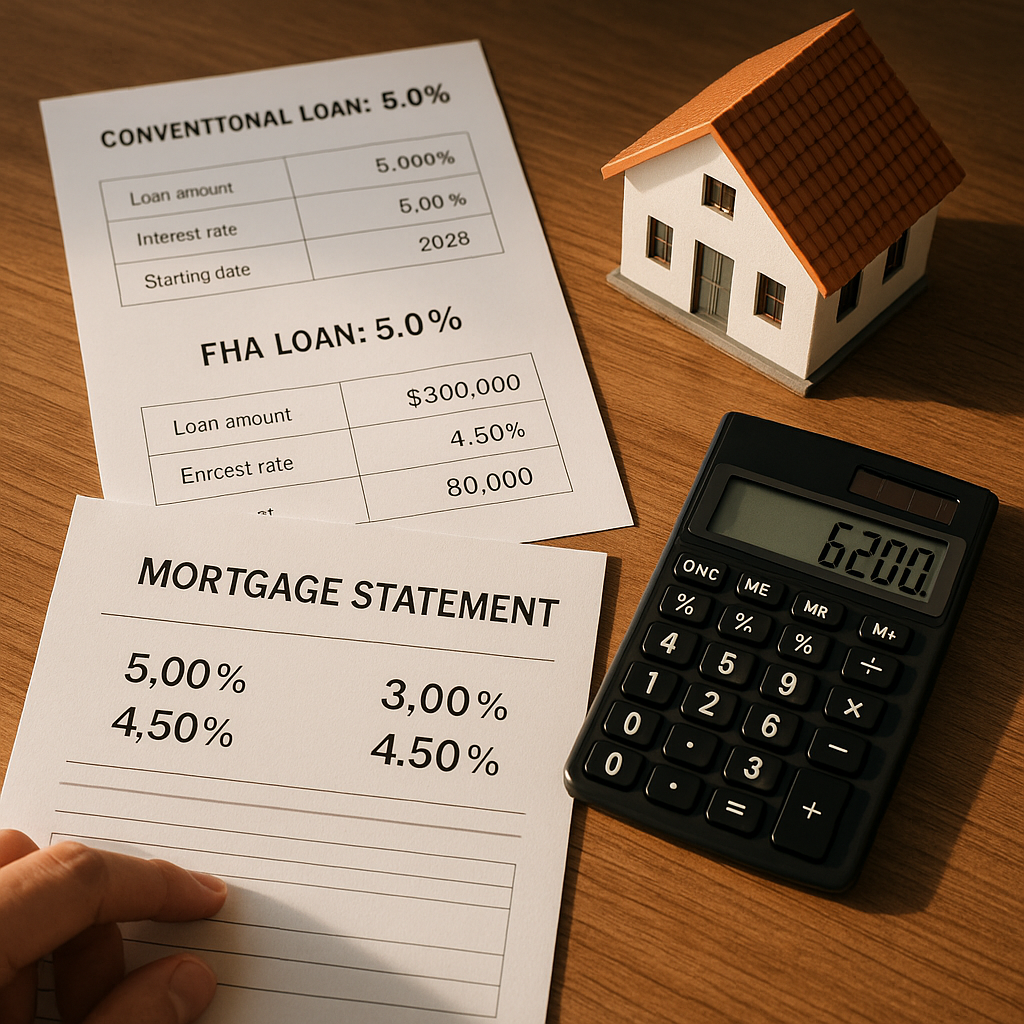
A homeowner sitting on a 3.5% FHA loan from 2021 should almost never refinance into a 6.5% conventional loan, even to escape MIP. But a homeowner with a 5.5% FHA loan from 2023 who’s already crossed 20% equity probably should run the math today. Most readers fall somewhere between those two cases, and the answer comes down to four numbers that fit on the back of a mortgage statement.
The short answer: when an FHA-to-conventional refi makes sense in 2026
The “clear yes” case
Your FHA note rate sits within roughly 0.5 percentage points of today’s available conventional rate, your loan-to-value is at or below 80%, and you plan to stay put for at least three more years. Killing the 0.55% annual MIP (plus a small rate improvement on top) usually pays back closing costs in 24 to 36 months.
The “clear no” case
Your FHA rate is two percentage points or more below current conventional rates. The MIP savings can’t offset the higher interest you’d pay every month for the life of the new loan. And this applies to most FHA borrowers who closed in 2020 and 2021.
The middle cases that need real math
Your rate gap is small, your equity is close to but not at 20%, or your holding period is uncertain. These borrowers actually need the break-even formula below.
The four variables that decide everything
1. Your FHA note rate vs. today’s conventional rate. Pull your last mortgage statement for the exact rate. As of April 23, 2026, the Freddie Mac PMMS 30-year fixed sat at roughly 6.23%, with quotes from Bankrate and Zillow ranging from about 6.51% to 6.73% on a same-week basis. Rates move daily.
2. Your current loan-to-value ratio. Divide your remaining principal by your home’s current market value. A free Zillow or Redfin estimate works for a first-pass check, though a lender will order a formal appraisal if you proceed. So if your principal is $240,000 and your home is worth $310,000, your LTV is about 77%, which clears the 80% gate with a little room.
3. Your monthly MIP cost and how many years remain. FHA loans originated after June 3, 2013 with less than 10% down carry MIP for the life of the loan. With 10% or more down at origination, MIP drops after 132 payments. Most 30-year FHA borrowers with small down payments pay 0.55% annual MIP. On a $250,000 balance that runs $114.58 per month.
4. Estimated closing costs. A typical conventional refinance runs $3,000 to $5,000 in lender and third-party fees, with some closings reaching $6,000 once prepaids and escrow funding get rolled in. Get a Loan Estimate from at least two lenders before assuming a number.
Today’s conventional refinance rate environment (April 2026)
Per Freddie Mac’s PMMS for the week of April 23, 2026, the 30-year fixed conventional refinance rate sat near 6.23%. Bankrate’s daily survey for the same period reported roughly 6.73%. NAR has forecast the 30-year fixed approaching 6% by year-end 2026.
The rate gap matters more than MIP on most loans. A borrower paying $115 per month in MIP saves $1,380 a year by killing it. But a borrower whose interest cost rises by 1.5 percentage points on a $250,000 balance pays roughly $3,750 more in interest over the first year alone.
The MIP savings doesn’t cover that.
The 80% LTV equity gate
To exit mortgage insurance entirely on the conventional side, the new loan amount has to be 80% or less of the appraised value. Below that threshold, the borrower swaps FHA MIP for conventional PMI, and the math usually fails unless the rate drop is large.
You can estimate your LTV in five minutes: pull your remaining principal from your most recent statement, get a value estimate from Zillow or Redfin, and divide. A formal appraisal during underwriting can come in below the online estimate (which happens more often than people expect), pushing you above 80% and forcing PMI onto the new loan. So build a buffer. Aim for 22% equity on the online estimate – the cushion you’ll thank yourself for the day an appraiser walks the property and shaves off three percent of value over a comp from six blocks away – before assuming a refinance pencils out at 80%.
Conventional PMI runs 0.3% to 1.5% of the loan amount annually, weighted heavily by credit score. A 760+ borrower might pay around 0.46%. A borrower in the 620 to 639 range can pay up to 1.5%. On a $300,000 loan the cost runs roughly $115 to $375 per month. Conventional PMI auto-cancels at 78% original-value LTV and is requestable at 80%.
How FHA MIP works in 2026
FHA charges an upfront MIP of 1.75% of the loan amount, paid at closing or rolled into the balance. Annual MIP runs from 0.15% to 0.75% depending on loan amount, term and original LTV. Most 30-year borrowers with less than 5% down pay 0.55%.
Two cancellation rules apply to loans originated after June 3, 2013. Loans with less than 10% down at origination carry MIP for the life of the loan. Loans with 10% or more down drop MIP after 132 payments.
Appreciation alone doesn’t cancel FHA MIP under either rule.
And that single fact is what pushes equity-rich FHA borrowers toward refinancing in the first place.
The break-even formula (with a worked example)
The formula:
Closing costs ÷ (Old P&I + Old MIP − New P&I − any new PMI) = months to break even
Worked example: closing costs of $4,500, FHA MIP of $137.50 per month eliminated, P&I roughly equal on the new loan. $4,500 ÷ $137.50 = 33 months, or about two years and nine months. A second scenario with $150 in monthly MIP eliminated: $4,500 ÷ $150 = 30 months.
But if the new conventional rate runs higher than the FHA rate, the denominator shrinks because the new P&I exceeds the old. A $250,000 balance refinanced from 4.5% FHA to 6.5% conventional adds roughly $290 per month in P&I. Even with $137.50 in MIP eliminated, the borrower pays about $152 more each month. The refinance never breaks even on cash flow.
Run this formula with your own statement before booking a lender call. Five minutes and a calculator answer the question for most borrowers.
The trap: trading a low FHA rate for a higher conventional rate
This is the single most common mistake among FHA borrowers chasing MIP elimination in 2026.
A 3.5% FHA loan refinanced to a 6.5% conventional loan on a $250,000 balance increases monthly P&I from about $1,123 to $1,580. That’s $457 more per month. Killing $115 in monthly MIP – the line item that probably triggered this whole search to begin with – leaves a net cash-flow loss of $342, plus closing costs on top.
So why do so many borrowers still chase this trade? Because $115 a month in MIP feels like wasted money you’re throwing into a federal program that already protects the lender, not you. It isn’t wasted if the alternative costs you $342 more, and it especially isn’t wasted if the alternative also locks in three extra percentage points of interest for the next thirty years.
Total your old payment (P&I + MIP) and your projected new payment (P&I + any PMI) before anything else. If the new total is higher, MIP elimination can’t save you.
Alternatives if the math does not work
An FHA Streamline refinance lowers the rate without an appraisal and with reduced documentation, though MIP continues, and it works for borrowers with low equity and an FHA rate above current FHA rates. Waiting for the 11-year auto-cancel makes sense for borrowers within 18 to 24 months of the cutoff who already have a competitive FHA rate. And lender-paid mortgage insurance on a conventional refinance bakes the PMI cost into a slightly higher rate, which helps in tight cases but rarely wins over a long hold.
Pending legislation watchlist
A bipartisan bill introduced in September 2025 would allow FHA MIP cancellation at 78% LTV, mirroring the conventional PMI rule. Status as of April 27, 2026: introduced, not enacted. So if the bill passes, many borrowers currently weighing a conventional refinance would be better served waiting for cancellation under the new rule. Confirm current status before acting.
Risks that can blow up the calculation
A soft appraisal can come in below the online estimate and push the new loan above 80% LTV, forcing PMI onto a refinance you modeled assuming no PMI. Conventional underwriting applies tighter DTI limits than FHA, so borrowers who qualified under FHA-relaxed standards may not requalify. And selling before the break-even point converts the refinance into a net loss. If your holding period is under three years, the math rarely works.
This might not be right for you
A HUD-approved housing counselor offers free or low-cost guidance on FHA refinance decisions, and they’re worth a call before signing anything. Consider reaching out if your equity is borderline, if your DTI runs tight or if you aren’t sure how long you’ll stay in the home.
Frequently asked questions
Is it worth refinancing from FHA to conventional in 2026? Only when your FHA rate is close to today’s conventional rate, you have 80% LTV or better, and you plan to stay three or more years.
How much equity do I need to refinance FHA to conventional without PMI? 20% at the appraised value at closing, which means an 80% or lower LTV.
Can I remove FHA MIP without waiting 11 years? Yes, by refinancing into a non-FHA loan. Appreciation alone doesn’t remove FHA MIP under post-2013 rules.
What is the break-even point on an FHA-to-conventional refinance? Closing costs divided by monthly savings (old P&I + MIP minus new P&I minus any PMI). Cases that pencil out typically break even in 24 to 48 months.
How much does it cost to refinance an FHA loan to conventional? Typically $3,000 to $5,000 in lender and third-party fees, with some closings reaching $6,000 once prepaids are included.
Will the 2025 FHA MIP cancellation bill change refinance math? It would if enacted, by allowing cancellation at 78% LTV. Status as of April 27, 2026 is introduced, not law.
What credit score do I need to refinance from FHA to conventional? Most conventional lenders require 620 minimum. A score of 680+ unlocks better PMI pricing if PMI applies. Verify with your lender.
Does an FHA-to-conventional refinance require a new appraisal? Yes. Conventional refinances require a full appraisal, unlike the FHA Streamline product.
Confirm current rate, MIP factor and PMI pricing with at least two lenders before applying.